S | M | S

admin

Congratulations, Mr. Rose!

Congratulations, Mr. Rose! Tim brings a unique perspective to the defense of Workers’ Compensation as a former claims examiner. With over 20 years of experience in the industry and a Certified Specialist designation from the State Bar in Workers’ Compensation, he continues to bring an aggressive defense to all of his cases and clients. We are glad to have him as our newest Equity Partner. Search for: Search Archives Archives Select Month September 2026 April 2020 March 2020 January 2020 November 2019 October 2019 September 2019 March 2019 February 2019 January 2019 August 2017 Subscribe To Our Blog First Name Last Name Email * Edit Template

Congratulations, Mr. Rose! Read More »

What constitutes improper ex-parte communication with a medical-legal evaluator?

What constitutes improper ex-parte communication with a medical-legal evaluator? Labor Code § 4062.3 provides in relevant part the following: (e) All communications with a Qualified Medical Evaluator selected from a Panel before a medical evaluation shall be in writing and shall be served on the opposing party 20 days in advance of the Evaluation. Any subsequent communication with the Medical Evaluator shall be in writing and shall be served on the opposing party when sent to the Medical Evaluator… (g) Ex parte communication with an Agreed Medical Evaluator or Qualified Medical Evaluator selected from a Panel is prohibited. If a party communicates with the Agreed Medical Evaluator or the Qualified Medical Evaluator in violation of subdivision (e), the aggrieved party may elect to terminate the medical evaluation and seek a new evaluation from another Qualified Medical Evaluator to be selected according to Section § 4062.1 or § 4062.2. Keeping this in mind it is also well understood that Rule 35(b)(1) allows for some direct communication with a Medical Legal Evaluator or the physician’s staff “relative to non-substantive matters such as the scheduling of appointments, missed appointments, the furnishing of medical records and reports, and the availability of the report” The recent WCAB decision in Lon Martinsen v. H&H Enterprises/Zenith Insurance (2023), 88 Cal.Comp.Cases 638 tackled the issue of what constitutes improper ex-parte communication that would justify an Order for a Replacement Panel of medical-legal evaluators. While the case decision has not been designated as a “significant” decision and was not en banc decision (decided by the entirety of the Workers’ Compensation Appeals Board), it is nonetheless an insightful look into the issues and disputes that can arise in our cases. In Martinsen, the Panel of WCAB commissioners issued a “split decision” (two in favor and one dissent) in which it was determined that communication from a Panel Qualified Medical Evaluator to applicant’s attorney’s office did not rise to the level of ex-parte communication despite several disconcerting facts and circumstances. The QME made contact with applicant attorney’s office to inquire into whether or not previously submitted surveillance videotape should be reviewed, and when it should be reviewed. At Trial, the Judge found that the applicant’s attorney’s office had engaged in ex-parte communication and ordered a new Panel to be issued. On Appeal to the WCAB, the majority determined that based on the facts and circumstances that there was no nefarious attempt to conspire with applicant’s attorney and the communication with applicant’s attorney’s office was a simple request for clarification on when and whether the QME should review surveillance video. The underlying facts of the case reveal that there was a dispute pertaining to whether or not the QME should have been replaced on multiple issues. During the litigation, the QME reached out on a unilateral basis to applicant’s counsel to inquire into whether or not he should review surveillance video. This was viewed by the WCAB majority as an innocent and non-substantive piece of communication relative to the issuance of a report. However, there was a dissent issued by the third commissioner, contending that the conduct by the QME rose the level of improper ex-parte communication in violation of Labor Code § 4062.3. The dissenting commissioner looked to a prior Court of Appeals decision in the case Alvarez v. WCAB (2010), 75 Cal.Comp.Cases 817, in which the Court had opined that an unqualified prohibition on ex-parte communication requires no showing of prejudice to invoke the appropriate remedy. Furthermore, the Alvarez court stated that this “strict rule” against ex-parte communication is justified in a field where the “impartiality and appearance of impartiality of the Panel Qualified Medical Evaluator is critical” The dissent went on to indicate that it agreed with the Trial Judge’s conclusion that the communication between the QME and applicant’s attorney’s office was an improper ex-parte communication, in that it was completely unclear why the physician sought clarification solely from applicant’s attorney regarding "when and how to proceed" with respect to viewing and commenting upon surveillance video. Standing alone, the commissioner stated that this communication may appear inconsequential. However, taken together with other conduct by the doctor’s office, including an earlier phone call with only applicant attorney’s office, as well as the physician’s denial of documentation of this communication during his deposition, and lack of disclosure of this documented communication to a defense in response to a subpoena, the evidence in the record is sufficient to “tip the scale” to reflect an appearance of impropriety by the QME that may only be remedied by a new physician. Again, while this was a panel decision by the WCAB and is not necessarily binding upon all Judges, it is nonetheless an insightful and revelatory decision. The issues concerning what constitutes ex-parte communication is in some instances extremely nuanced and will be determined by issues pertaining to how “consequential” the communication with a Physician turns out to be. As such, we here at Siegel, Moreno & Stettler had a few takeaways from this split decision: 1. In our view, the communication does not need to be “prejudicial” or in any way nefarious to be considered arguably ex-parte communication violation of Labor Code § 4062.3. While the majority opinion in this particular case focuses upon the potential motive behind the communication, we will continue to argue that motive is not the determining factor. Instead, the overall impropriety or the appearance of impropriety is of paramount importance: 2. Details matter. In our view, whether or not we can establish improper ex-parte communication depends upon the entirety of the parties conduct, not just one or two cherry-picked details. In this case, the dissenting Commissioner made very valid points that when viewed in a vacuum, one bit of communication between a QME and applicant attorney’s office may not be so consequential, but taken in light of the fact that the physician’s office failed to disclose evidence of prior communication within subpoenaed records to the defendant, and also denied this prior communication at the time of deposition,

What constitutes improper ex-parte communication with a medical-legal evaluator? Read More »

Potential Expansion of Presumptions for PTSD

Potential Expansion of Presumptions for PTSD In the ever-changing landscape of California Workers’ Compensation, lawmakers have proposed numerous bills during the current legislative session which would make many additional presumptions and provide workers with additional benefits. There are currently approximately five legislative proposals that would make law enforcement employees, lifeguards, nurses, first responders, and prison employees eligible for presumptions stating that a claim for post-traumatic stress disorder is compensable. Lawmakers are currently concerned that first responders are more susceptible to PTSD based on the nature of their employment. Below are a list of current proposals that seek to expand the scope of presumptions: AB 1107– This bill would addadditional employees from the Department of Corrections and Rehabilitation and California State University Police Departments to the PTSD presumption. This bill would have the most impact on employees responsible for law enforcement activities, including transporting inmates. AB 1156– This bill would create a presumption forworkers at acute care hospitals providing direct patient care. This bill would presume that infectious diseases, orthopedic injuries, PTSD, cancer, and various respiratory diseases are work-related. AB 1145– This bill would create a new PTSD presumption forqualified state medical providers working for the Department of Corrections and Rehabilitation, the State Department of Developmental Services, and the State Department of State Hospitals. Please note this includes psychiatric technicians, registered nurses, and other medical and social service providers. AB 699– This bill expands existing presumptions forfull-time members of the City of San Diego Fire-Rescue Department’s Boating Safety Unitand extend the existing timeframe for them to file. It would also expand the list of existing presumptions to include PTSD or exposure to biochemical substances. AB 597– This bill attempted to addpublic safety dispatchers(amended this bill on Feb. 23 to remove public safety dispatchers from the proposal).Paramedics, emergency medical technicians, and more firefighterswould be added to the existing PTSD presumption. OUR TAKE Currently, these bills are still in preliminary discussion and not necessarily close to becoming law. The bills would have to be approved by both the State Senate and the State Assembly. The Governor would have to sign them into law. However, if passed, these proposals are disconcerting as they propose a significant expansion in scope of presumptions and creates a “slippery slope” with no end in sight. The outcome is unknown, and we will continue to monitor these bills and their eventual outcome. Search for: Search Archives Archives Select Month September 2026 April 2020 March 2020 January 2020 November 2019 October 2019 September 2019 March 2019 February 2019 January 2019 August 2017 Subscribe To Our Blog First Name Last Name Email * Edit Template
Potential Expansion of Presumptions for PTSD Read More »

Congratulations, Mr. Shrivastava

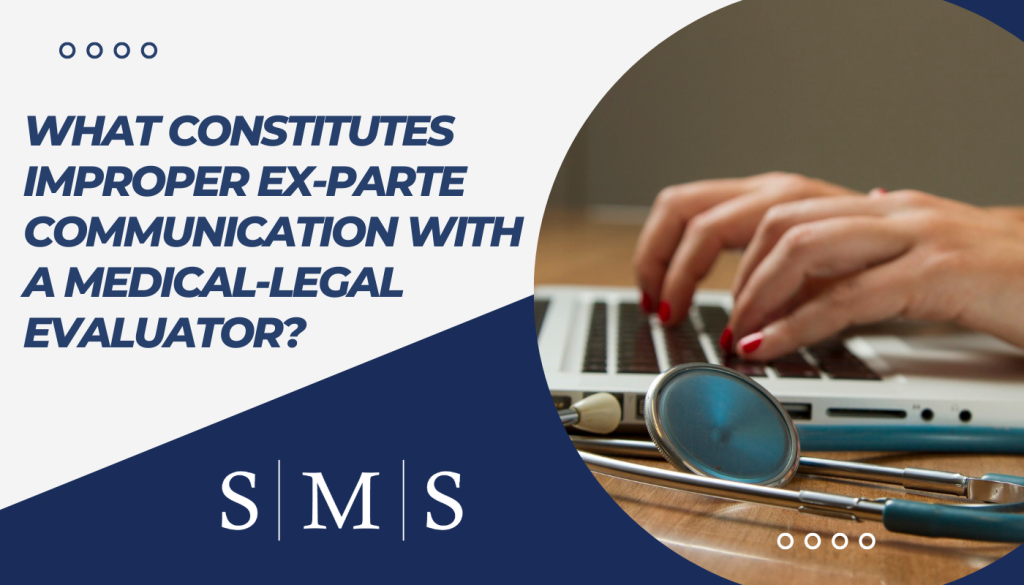
Congratulations, Mr. Shrivastava For almost 18 years, Sunny has vigorously defended his clients’ interests throughout Southern California. His expertise has proven to be an asset to our firm and we are excited to bring him on board as our newest partner. Search for: Search Archives Archives Select Month September 2026 April 2020 March 2020 January 2020 November 2019 October 2019 September 2019 March 2019 February 2019 January 2019 August 2017 Subscribe To Our Blog First Name Last Name Email * Edit Template
Congratulations, Mr. Shrivastava Read More »

Congratulations, Mr. Hermanson!

Congratulations, Mr. Hermanson! Phil has long been a zealous advocate for his clients, defending claims in the Inland Empire, Orange County and San Diego. We are proud to have him as a Partner with the firm. Search for: Search Archives Archives Select Month September 2026 April 2020 March 2020 January 2020 November 2019 October 2019 September 2019 March 2019 February 2019 January 2019 August 2017 Subscribe To Our Blog First Name Last Name Email * Edit Template

Congratulations, Mr. Hermanson! Read More »

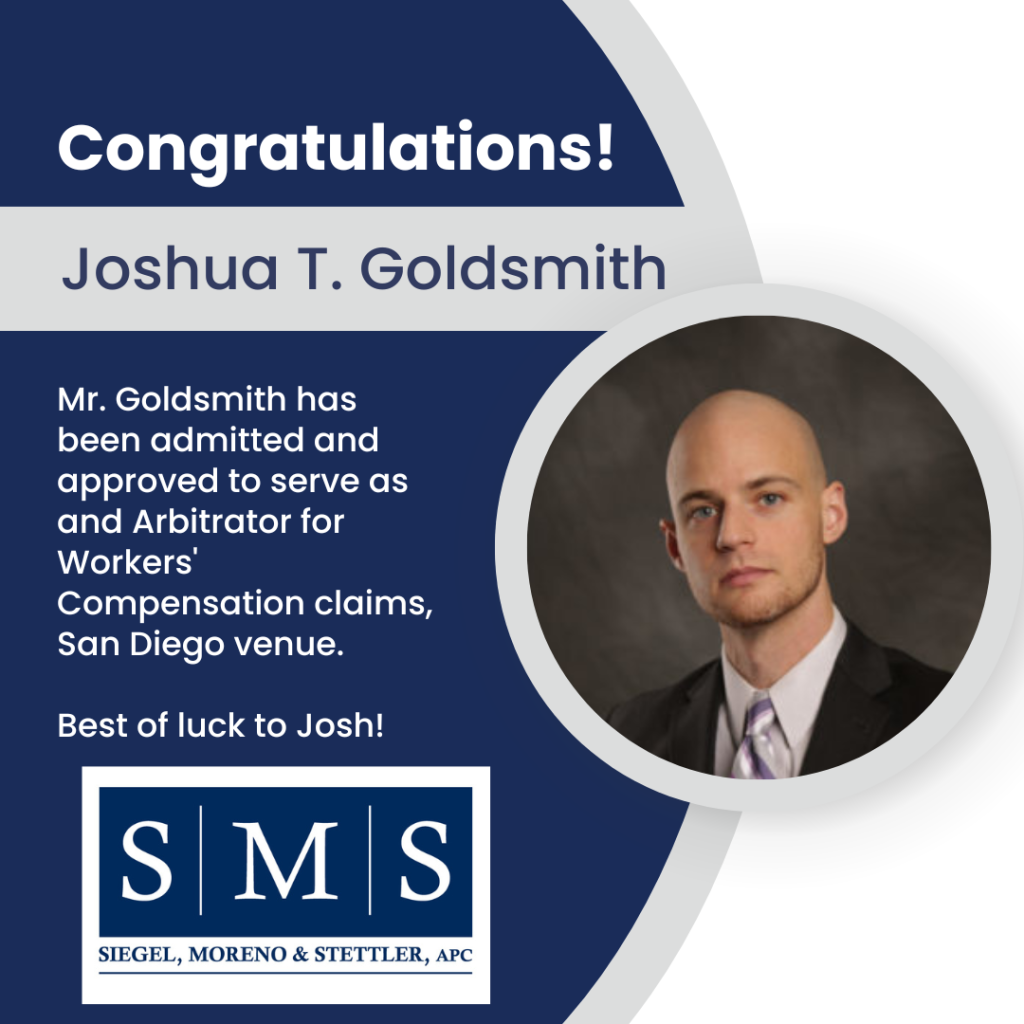
Congratulations, Mr. Goldsmith!

Congratulations, Mr. Goldsmith! Mr. Goldsmith has been admitted and approved to serve as and Arbitrator for Workers’ Compensation claims, San Diego venue. Best of luck to Josh! Search for: Search Archives Archives Select Month September 2026 April 2020 March 2020 January 2020 November 2019 October 2019 September 2019 March 2019 February 2019 January 2019 August 2017 Subscribe To Our Blog First Name Last Name Email * Edit Template
Congratulations, Mr. Goldsmith! Read More »

Successfully Identifying Workers’ Comp Recovery Opportunities

Successfully Identifying Workers’ Comp Recovery Opportunities Subrogation in the context of Workers’ Compensation A day in the life of a Worker’s Compensation Claims Professional can be hectic to say the least! New losses that demand immediate attention come in continually. Each claim brings in calls and correspondence from applicant attorneys, doctors, employers, case managers, investigators, defense attorneys, lien claimants, and injured workers. Each request for treatment and report brings rules and deadlines around every corner. Supervisors require diary review, updates, and plans of action, and clients seek account audits. And on top of all that, the claims professional is also responsible for identifying subrogation recovery potential for each claim. That picture is daunting, but subrogation does not have to be a thorn in the claims professional’s side. Familiarity with basic workers’ compensation subrogation fact patterns and the steps to take once they have been identified can ease this task. In general, subrogation in the context of a workers’ compensation case comes in several distinct fact patterns. Motor vehicle accidents Construction site accidents Premises liability Products liability Miscellaneous patterns Let us explore some fundamentals for each. Motor vehicle accidents (MVA’s) MVA’s are the easiest fact pattern to identify with subrogation potential. When a report comes in that mentions an injury that was caused by a car accident, subrogation should be pursued to determine who was at fault for the accident. Some initial and quick steps can be completed to insure proper investigation is completed and recovery is obtained. These include: 1. Securing a copy of the police report is key for this purpose. Once the report is received, the responsible driver and owner should be put on notice of the carrier’s intent to pursue subrogation. 2. A demand must be made for the insured to open a claim with their auto insurance carrier. 3. A request should be made to the employer and employee for any photographs of the vehicles involved, documentation of any repairs made to the vehicles involved, and a statement made by anyone involved in the accident or who witnessed it. Construction site accidents Accidents on construction sites come in all shapes and sizes. Early identification of subrogation potential is paramount because the scene of the accident and instrumentation involved often can change quickly. Even a short delay of a few days in getting a subrogation inquiry up and running can prejudice the chances of recovery. Thus, when an injury comes in and the employer identifies the accident locale as a construction site, an immediate subrogation review needs to be done. Common fact patterns include: Injuries involving heavy machinery or scaffolding Falls from heights Materials falling and striking workers Failures to guard against dangerous conditions Once subrogation potential is identified, requests should be made for: Witness statements OSHA reports Contractor reports Premises liability – slip, trip, and fall scenarios These cases are the most often overlooked by claims professionals and insured employers. They are also often discounted quickly on the assumption that it was nothing more than an accident caused by the injured worker not paying attention. While contributory fault of the injured worker is a consideration in all premises liability cases, it does not mean that there is no subrogation potential. Any time an injury involves a slip, trip, fall, or some other accident caused by an encounter with a condition present on the property, the claims professional should take a moment to step back and consider whether a third party was involved in creating the condition that led to the injury. Once identified, photographs of the condition responsible for the injury should be secured immediately. Products liability These cases have the most obvious fact patterns but can be the most expensive and problematic to pursue. Whenever an injury occurs due to an encounter with a machine, tool, or piece of equipment, subrogation should be considered. Discussions with the employer and employee should focus on whether a defect or failure of the equipment contributed to the accident. Quite often, these situations involve contributory fault of the injured worker and employer surrounding misuse of equipment or failure to train. Nonetheless, if the scope of the injury is large, at least a basic analysis of product design or manufacturer defects should be completed. Securing a copy of the OSHA report often can assist in the fact gathering and analysis of the issues involved. In very serious cases, an expert should be consulted early on to inspect the product. Ultimately, these cases hinge on the testimony and opinion of an expert concerning the product. Miscellaneous patterns Not all subrogation fact patterns fit neatly into a category. Any time an accident occurs and you find yourself asking,  “How did that happen?”, It is probably a good indication that there may be subrogation potential. Follow that intuition by asking questions of the employer and employee to determine whether a third party potentially could be involved in the cause of the injury. If there is ever a doubt, it is better to be safe than sorry. Remember, help is always available from subrogation specialists, vendors, or attorneys who can assist with the questions to ask and evidence to preserve to make sure that subrogation opportunities are not missed. A phone call is all it takes to get started! Search for: Search Archives Archives Select Month September 2026 April 2020 March 2020 January 2020 November 2019 October 2019 September 2019 March 2019 February 2019 January 2019 August 2017 Subscribe To Our Blog First Name Last Name Email * Edit Template

Successfully Identifying Workers’ Comp Recovery Opportunities Read More »

A review of the 2021 DIR Audit findings

A review of the 2021 DIR Audit findings The 2021 audit regarding claims handling practices has been released and is available for public review. A copy of the report can be found here: https://www.dir.ca.gov/dwc/AuditUnit/Audit-Annual-Report2021.pdf For a link to the general DIR website for the Audit and Enforcement Unit which has the report and other information can be found here. https://www.dir.ca.gov/dwc/audit.html The purpose of the audit report is to ensure insurers, self-insureds and third part administrators are properly addressing indemnity and medical benefits management. The audit results point out issues in these areas and administrative penalties are assigned. For most of the general population, I’ll wager you did not do a deep dive into the report. For us Work Comp nerds, it was a Godsend for those cold nights when we want nothing else other than to cuddle up by a roaring fire in our PJ’s with a cup of hot chocolate and a good read, namely, audit reports! Rest assured, there are some great nuggets of information any examiner can use in their daily case management. Takeaways The largest number of violations surround indemnity benefits. Notably, untimely first payment of TTD and PD benefits and/or subsequent payments. There were also multiple violations for inaccurate benefit notices or failure to provide any notice at all. Other notice violations include failure to serve notice of a QME or AME evaluation. This one was a bit of a surprise as defense counsel would normally be the one to handle that notice on represented cases. I assume this would primarily apply to unrepresented matters. Other violations include failure to document (properly) claim log entries. There were also a sizeable number of violations regarding timely payment or objection to medical treatment expenses. So why is this important? I think this demonstrates the need to return to basics when it comes to claims and adjusting of your caseload. When I was a claims examiner, I often found myself delving into caselaw, complex legal arguments and spending a lot of time addressing what I called the “minutiae” items. Which are important. But I tried my best to not lose sight of the basics: timely payment of benefits, timely medical care approval, good documentation of claims notes, and addressing disputes and denials. In the end, these are the items that claims examiners would spend most of their time on. As technology has improved, it is easier than ever to make sure things are set to automatic payment, easier form and templates for correspondence, and easier note taking options. But as this audit demonstrates, no one is perfect. Examiners have a tough job of complying with timelines, codes, statutes, and caselaw. They make hundreds of decisions a day. And after their tasks and requirements are met, they also must ensure their support staff also are accurately documenting files, sending correspondence, and serving documents to dozens of parties per day. And lets be honest; applicant attorneys are good at addressing errors and do demand costs and sanctions in the process. The final lessons are simple: return to the basics and use all the tools you have in the process. Spend the time to ensure each file has properly paid and scheduled indemnity benefits. Make sure file and serves are completed timely, and routinely. Stay on top of your mail and email. And, make sure you address errors timely and promptly to keep small issues from turning into larger ones. And for defense attorneys like me? We need to make it a priority to assist in these duties and make sure we are timely litigating all issues. We need to ensure regular contact with our clients. And we need to be better about putting out those small fires on the corner of our desk before the entire office is consumed in a bonfire. May the 2022 audit bring about fewer violations and less audit penalties! Search for: Search Archives Archives Select Month September 2026 April 2020 March 2020 January 2020 November 2019 October 2019 September 2019 March 2019 February 2019 January 2019 August 2017 Subscribe To Our Blog First Name Last Name Email * Edit Template
A review of the 2021 DIR Audit findings Read More »

Revisiting the See’s Candies (Ek) decision and employer duty of care

Revisiting the See’s Candies (Ek) decision and employer duty of care A number of months ago, I completed an assessment of the See’s Candies Inc. v. Superior Court (Ek) decision. For a review, please visit this post for more background. The See’s decision discussed the long- standing Derivative Injury doctrine, which is a doctrine that states Workers’ Compensation exclusivity applies to all claims that are collateral to or derivative of a compensable injury in the Workers’ Compensation injury. It was my opinion that the case potentially put a large dent in this exclusive remedy rule, thus opening the potential for sizeable and I would argue, largely unforeseeable liability for employers who already face some heavy burdens in this system of ours. In April, after reviewing the lower court and appellate decisions, the Supreme Court declined to review this decision without comment after See’s Candies petitioned the December, 2021 decision of the 2 nd District Court of Appeal (see See’s Candies Inc. v. Los Angeles Superior Court et al.). The final decision of this case in essence bars a claim where it is a legal impossibility to state a cause of action without alleging a disabling or lethal injury to an employee. However, it does not bar claims with only a causal link to an industrial injury. But is this the end? Have we reached the finality of employer liability? No! The issue over duty of care of the employer was not addressed. Which is the second issue a party will need to address to successfully prevail in a tort action. Why was it not addressed? I think it was the decision of the court to not address this issue due to another case making its rounds through the lower courts at the time See’s Candies was headed up to the Supreme Court. Enter Kuciemba v. Victory Woodworks, 2021 U.S. Dist. LEXIS 88997; 2022 U.S. App. LEXIS 10786 9 th Circuit Court of Appeals. Some of the facts of this case ring similar to that of See’s, though there are some distinct differences. In the Kuciemba matter, both the employee and his spouse were hospitalized due to COVID-19 he contracted at work. The spouse sued for damages alleging negligence and public nuisance while her spouse sued for loss of consortium. Initially, the Federal District Court granted the employer’s motion to dismiss under the Exclusive Remedy doctrine, though the Court of Appeals certified specific questions related to COVID to the Supreme Court of California. The Supreme Court will ultimately address two issues. First, if the Derivative Injury rule bars the claims of the couple. Second, whether the employer owes a duty of ordinary care to members of the household. And thus, the second issue not addressed in See’s appears to be on its way to being answered. Basic Tort law addresses duty of care and negligence all the time but the big unanswered question is how far does that duty extend? While there is a general duty for employers to provide employees with a safe work environment, it is my opinion that opening the door to the household of the employee as wide as both See’s and Kuciemba would potentially allow would be disastrous to employers and employees alike. And with COVID-19 and the resulting changes with remote employment opportunities which I believe has largely been a benefit to employer and employee alike, we would likely see a very rapid return to in-person work only so that the employer can better control the “workplace” and potential liability in general. The employer duty to the household was addressed in another case that does give us a roadmap of sorts as to the thoughts of the State of California in imposing liability on the employer for incidents that occur in the home. The Colonial Van decision (see Colonial Van & Storage, Inc. v. Superior Court, 76 Cal. App. 5 th 487 (2022), which involved a most unfortunate series of events, discussed a duty of care in the home. In that case, a married couple both worked for the company. The wife was a supervisor and could work from home. She often invited co workers to her home for work-related meetings and other events. One evening, they invited a coworker and business associate (and sadly, an infant also was in the home) to dinner where they discussed both work and non work-related items and tasks. Their son, who suffered from PTSD, suddenly left the dinner table and returned with a firearm and started shooting, killing his stepfather and wounding everyone else. Colonial and the employee were sued for negligence and intentional infliction of emotional distress. On Writ of Petition to the Court of Appeal, the court addressed the issue of whether an employer has a duty to address safety of persons at an off-site work location from third party action. Ultimately, the case was dismissed with the court concluding that an employer does not have a duty to protect work from home employees from third-party criminal conduct. The court analyzed if the employer had a duty to protect employee’s at home, which is a location they do not own nor possess. They ultimately refused to impose a duty, at least as it pertains to tortious activity of a third party. Next, they considered if the employer was deemed to have exercised control over the employee’s home if it enjoys a commercial benefit from the use of the home. Ultimately, a mere commercial benefit was not sufficient. Next, the court held that an injured coworker could not rely upon an employer-employee relationship to impose a duty on the employer. Next, the Court determined that the harm was not foreseeable and that Colonial had no actual knowledge of risk. Finally, the Court considered public policy against imposing liability. In essence, they claimed that public policy weighed heavily against imposing a duty against the employer, arguing that liability for the employer would create an “unrealistic obligation.” With this case in mind, a determination of employer liability in the

Revisiting the See’s Candies (Ek) decision and employer duty of care Read More »

Beware only filing a subrogation lien

Beware only filing a subrogation lien If your work comp subrogation action involves the death of the injured worker, best practice is that you file an independent subrogation action to protect the statute. Doing anything short of that could spell disaster for your recovery efforts and net a zero in recovery. Here’s a situation: An insured worker dies in a motor vehicle accident that was not his fault. Subrogation potential! The work comp carrier pays out a substantial sum to settle the claim. The injured worker’s family gets a personal injury attorney and files a lawsuit. The employer/carrier does not file suit to protect the statute. Instead, the employer/carrier just communicates with the plaintiff attorney and waits to assert its lien off the personal injury settlement. The case settles and plaintiff dismisses his case without paying the comp carrier. The plaintiff attorney for the worker’s family tells the carrier that there was only one cause of action for wrongful death and the carrier’s lien doesn’t attach it. He is not reimbursing the carrier a dime. The plaintiff attorney is RIGHT! I’ll discuss the details below. Don’t get caught If there is a death claim, never file a lien OR an intervention. The only real way to protect yourself is by filing a separate complaint to protect the statute. Because: The lien could end up being worthless depending on how the plaintiff attorney crafts the complaint. Intervention may fail as well for the same reason the lien fails. Employer/carrier has no recovery rights for wrongful death so it doesn’t protect their rights or toll the statute. Relevant Law: Wrongful Death:CCP § 377.60 establishes a separate statutory cause of action in favor of specified heirs of a person who dies as a result of the “wrongful act or neglect” of another. Under a wrongful death cause of action, the specified heirs are entitled to recover damages on their own behalf for the loss they have sustained by reason of the bodily injury victim’s death. [See Corder v. Corder (2007) 41 C4th 644, 651, 61 CR3d 660, 664; Fitch v. Select Products Co. (2005) 36 C4th 812, 819, 31 CR3d 591, 595; Boeken v. Philip Morris USA Inc. (2013) 217 CA4th 992, 997, 159 CR3d 195, 198 (discussed at ¶ 3:2242)] The elements of a wrongful death action are a tort (negligence or other wrongful act), resulting death (causation), and loss (damages) suffered by the heirs. When the tort is negligence, plaintiff must, of course, prove defendant’s duty and breach thereof. [Lattimore v. Dickey (2015) 239 CA4th 959, 968, 191 CR3d 766, 773; Jacoves v. United Merchandising Corp. (1992) 9 CA4th 88, 105, 11 CR2d 468, 478]. “Survival” action:A wrongful death claim is separate and distinct from the victim’s action which “survives” to the estate under CCP § 377.20 (¶ 3:285 ff.). Whereas damages recovered in a “survival” action belong to the victim’s estate, damages recoverable in a wrongful death action belong to the parties-plaintiff personally—wrongful death damages are not part of the victim’s estate and do not descend through the estate. [CCP § 377.60; see Castaneda v. Department of Corrections & Rehab. (2013) 212 CA4th 1051, 1063, 151 CR3d 648, 656-657; Adams v. Sup.Ct. (Centinella Freeman Regional Med. Ctr.) (2011) 196 CA4th 71, 78-79, 126 CR3d 186, 192; also see Ross & Cohen, Cal. Prac. Guide: Probate (TRG), Ch. 15] Damagesrecoverablein WD Action:As a general rule, each wrongful death claimant is entitled to damages for all detriment personally suffered and is likely to suffer in the future because of decedent’s death. The measure of damages is not limited to out-of-pocket losses; rather, it covers the total value of the benefits the claimants could reasonably expect to receive had decedent lived. [Corder v. Corder (2007) 41 C4th 644, 663, 61 CR3d 660, 674; Boeken v. Philip Morris USA Inc. (2013) 217 CA4th 992, 997-998, 159 CR3d 195, 198-199; Allen v. Toledo (1980) 109 CA3d 415, 423, 167 CR 270, 275; CACI 3921 (death of adult), 3922 (death of minor); and see BAJI 14.50, 14.52] Damages recoverable by estate in CCP § 377.30 “survivor” action:Expressly excluded from a wrongful death recovery are damages awardable under CCP § 377.34 to compensate the estate for detriment decedent personally suffered before death. [CCP § 377.61] Thus, wrongful death claimants are not entitled to damages for: Medical expenses incurred by decedent prior to death; Decedent’s wage losses or impaired earning capacity; Decedent’s pain and suffering and/or damages for disfigurement. [See Fitch v. Select Products Co. (2005) 36 C4th 812, 819, 31 CR3d 591, 595; Corder v. Corder (2007) 41 C4th 644, 661, 61 CR3d 660, 672; DeMeo v. St. Francis Hosp. (1974) 39 CA3d 174, 176-177, 114 CR 280, 281-282] Workers’ compensation “recoupment” rights:An employer or insurer is entitled to bring an action against a third party tortfeasor to recover payments made as a proximate result of injury to or death of an employee (including death benefits paid to the Department of Industrial Relations in cases of decedents without dependents). [Lab.C. § 3852] This “recoupment” right derives from the tort remedy the injured employee would have had but for the death.It is wholly distinct from the § 377.60 claimant’s independent (nonderivative) right to sue for decedent’s wrongful death. [Eli v. Travelers Indem. Co. (1987) 190 CA3d 901, 235 CR 704] Contact me for information about how you can protect yourself against wrongful death suits. Search for: Search Archives Archives Select Month September 2026 April 2020 March 2020 January 2020 November 2019 October 2019 September 2019 March 2019 February 2019 January 2019 August 2017 Subscribe To Our Blog First Name Last Name Email * Edit Template

Beware only filing a subrogation lien Read More »