S | M | S

admin

Average weekly wage (AWW) Increase for 2025 Released for Workers Compensation Claims

Average weekly wage (AWW) Increase for 2025 Released for Workers Compensation Claims Per the State of California, the State Average Weekly Wage (SAWW) rose nearly 3.8% in the year ending March 31, 2024, which will result in an increase in California workers’ compensation temporary total disability (TTD) and permanent total disability (PTD) rates for 2025 work injury claims and other workers’ compensation benefits that are tied to SAWW increases. Wage data from the US Department of Labor demonstrate the increase of 3.8% (rounded up) from $1,642.00 to $1,704.00. The TTD/PTD maximum rate will increase by an additional $61.14 to $1,680.29 per week for claims with injury dates on or after January 1, 2025. The minimum weekly TTD/PTD rates will increase by $9.17 to $252.03 per week for claims with 2025 injury dates. Other potential workers’ compensation benefits including life pension, PTD payments post January 1, 2023, death claim installment payments and TTD paid over two years post injury will also increase. Also beginning on January 1, 2025, other workers’ compensation benefits, including TTD paid two years or more after injury, life pension and PTD payments for injuries on or after January 1, 2003, and installment payments on death claims will be going up due to the SAWW increase. Underpayment of benefits results in penalties, so CWCI encourages claims administrators to review changes in benefit rates with legal counsel to assure that adjustments are appropriate and accurate. The State has provided a data table for reference, which shows the 12 months ending on March 31, 2023 and the 12 months ending on March 31. 2024, per the US department of Labor: https://oui.doleta.gov/unemploy/data_summary/DataSum.asp If you have questions on rates, changes to payments or the impact on any claim including increases in reserving, please reach out to any attorney at Siegel, Moreno & Stettler to learn more. Search for: Search Archives Archives Select Month September 2026 April 2020 March 2020 January 2020 November 2019 October 2019 September 2019 March 2019 February 2019 January 2019 August 2017 Subscribe To Our Blog First Name Last Name Email * Edit Template

Average weekly wage (AWW) Increase for 2025 Released for Workers Compensation Claims Read More »

AB 2337 signed into law, electronic signatures allowed, subject to AD/WCAB requirements/restrictions

AB 2337 signed into law, electronic signatures allowed, subject to AD/WCAB requirements/restrictions At long last, the State legislature has put to rest an ongoing issue that in my humble opinion, should not be a complicated or controversial one. That is, allowing electronic signatures on most documents in the Workers’ Compensation arena. Most notably, settlement documents. During the COVID-19 state of emergency, multiple, temporary changes were made to allow Workers’ Compensation matters to proceed with “business as usual”, to the fullest extent possible. This included allowing electronic signatures on important documents, such as settlement documents, to comply with restrictions on in person meetings and social distance requirements. I immediately noticed a sizable decrease change in the time it would take to get documents finalized and submitted to the court as applicant’s no longer had to wait for documents to be mailed to them for review. Nor did they need to schedule an appointment with their attorney to physically come to the office to complete forms, which could be an issue if they were working, had transportation issues, or if their attorney had a busy calendar. In 2023, the en banc decision No. 9, addressing Case No. MISC. NO. 268 rescinded all remaining provisions or prior en banc orders regarding the pandemic due to the state of emergency being deemed as ended by Governor Newsom. Since that time, there has been a lack of uniformity with WCAB offices regarding signatures and filing of documents. Some judges still seemed to allow electronic signatures while some indicated the signature on certain documents had to be a wet signature. AB 2337, signed before the end of the current legislative session clarifies the definition of a “signature” to allow for electronic signatures. An electronic signature is defined as “an electronic sound, symbol, or process attached to or logically associated with an electronic record and executed or adopted by a person with the intent to sign the electronic record, where the electronic signature is attributable to a person per the requirements of Title 2.5 (commencing with Section 1633.1) of Part 2 of Division 3 of the Civil Code or Section 16.5 of the Government Code.” Labor Code 110.5 and 3206.5 have been created as a result of this bill. This is good news and finally moves Workers’ Compensation matters in line with many other areas of law that allow for many contracts to be finalized with an electronic signature. The changes go into effect on 1/1/25. However, I have seen in the past week or so a few judges permitting electronic signatures at the present time on two settlement documents I have submitted for their review. Read the full Bill here. Search for: Search Archives Archives Select Month September 2026 April 2020 March 2020 January 2020 November 2019 October 2019 September 2019 March 2019 February 2019 January 2019 August 2017 Subscribe To Our Blog First Name Last Name Email * Edit Template

AB 2337 signed into law, electronic signatures allowed, subject to AD/WCAB requirements/restrictions Read More »

Major Lien Victory for Siegel, Moreno & Stettler: ! A Take Nothing on a hospital lien in an amount exceeding $522k

Major Lien Victory for Siegel, Moreno & Stettler: ! A Take Nothing on a hospital lien in an amount exceeding $522k Tim Rose of the Sacramento office has successfully defended a lien filed by John Muir Medical Center, successfully arguing at Trial that the lien claimant had failed to prove AOE/COE and that the applicant was an employee at the time the medical incident occurred or was performing duties on behalf of or for the benefit of the employer at the time of his incident. The Application for Adjudication was filed by the lien claimant after providing medical care for an individual who was treated for an intracranial hemorrhage, skull defect and other serious ailments. At the time of Trial, the lien claimant attempted to introduce new evidence not listed on the Pre-Trial Conference Statement through a Trial Brief with attachments. The evidence was successfully blocked from being introduced or considered at the time of Trial. The lien claimant has since withdrawn their lien and did not pursue Reconsideration. Read the full Findings and Order here. Search for: Search Archives Archives Select Month September 2026 April 2020 March 2020 January 2020 November 2019 October 2019 September 2019 March 2019 February 2019 January 2019 August 2017 Subscribe To Our Blog First Name Last Name Email * Edit Template

Major Lien Victory for Siegel, Moreno & Stettler: ! A Take Nothing on a hospital lien in an amount exceeding $522k Read More »

A Major Win for Siegel, Moreno & Stettler! A significant victory in the Court of Appeal, Fourth Appellate District Division One

A Major Win for Siegel, Moreno & Stettler! A significant victory in the Court of Appeal, Fourth Appellate District Division One FINDINGS FROM THE COURT OF APPEAL, FOURTH APPELLATE DISTRICT DIVISION ONE (APPLICANT) vs. ; (Permissibly self-insured, DEFENDANTS) Attorney for Defendants: Steven M. Siegel The claims by the Applicant alleged back in 1992, the employer arranged mammograms for all the employees. Applicant claimed to have had one of the mammograms and subsequently learned that she had damage to her breast implants. The case was denied and litigation involved the Applicant’s deposition as well as a number of hearings at the WCAB. The Applicant claimed a number of conspiracy theories including Judges, prior Attorneys, and the present Defense Counsel. Some of the theories included involvement with one of the Judge’s brother and the shooting in Las Vegas, references to Nazis and World War II, involvement of the CIA, and other novel ideas. The Writ was as a result of Defendant’s filing a Motion to Dismiss the Application and determine the Applicant to be a Vexatious Litigant pursuant to 8 CCR 10430(a). A Vexatious Litigant means: A party who, while acting in propria persona in proceedings before the Workers’ Compensation Appeals Board, repeatedly relitigates, or attempts to relitigate, an issue of law or fact that has been finally determined against that party by the Workers’ Compensation Appeals Board or by an appellate court; A party who, while acting in propria persona in proceedings before the Workers’ Compensation Appeals Board, repeatedly files unmeritorious motions, pleadings or other papers, repeatedly conducts or attempts to conduct unnecessary discovery, or repeatedly engages in other tactics that are in bad faith, are frivolous or are solely intended to cause harassment or unnecessary delay; or A party who has previously been declared to be a vexatious litigant by any state or federal court of record in any action or proceeding based upon the same or substantially similar facts, transaction(s) or occurrence(s) that are the subject, in whole or in substantial part, of the party’s workers’ compensation case. Under subsection (b), a party can be declared a Vexatious Litigant by Petition of a party, upon the Motion of any Workers’ Compensation Judge or the Appeals Board, the Presiding Workers’ Compensation Judge of any District Office having venue or the Appeals Board. This was accomplished in this case, with the Applicant being declared a Vexatious Litigant. As a result of being declared a Vexatious Litigant, subsection (d) states that Presiding Workers’ Compensation Judge or Appeals Board may enter a “prefiling” Order, in other words an Order which prohibits the Vexatious Litigation from filing in propria any Application, Declaration of Readiness, or a Petition without first obtaining leave of the Presiding Workers’ Compensation Judge for the Appeals Board. Under subsection (e), request from said Vexatious Litigant “conditionally filed” pending review by the Presiding Judge (in this case Honorable Clifford Levy), or the Appeals Board could determine if subsection (a) has been violated. If said request does not violate subsection (a), then it will be deemed to have been “properly filed”. Presiding Judge or Appeals Board may consider “whether there has been a significant change in circumstances (such as new or newly discovered evidence or a change in law) among other factors that might materially affect an issue of fact or law that was previously finally determined against the vexatious litigant. CASE BACKGROUND The Applicant had been determined a “Vexatious Litigant” considered the “prefiling review” of the Applicant’s conditional filing to determine whether the request would be accepted for filing. The main issue was whether or not the Applicant filed her Petition for Reconsideration timely. The Defendants Petitioned the Court to Dismiss the Application on the basis that the Applicant was a Vexatious Litigant. The Order Dismissing the Application was dated April 6, 2023, and the 25 day limit to file the Petition fell on May 1, 2023. There was also an issue as to whether or not prefiling review was conditional as a result of the Board accepting the Petition. It was at best confusing to determine what the Applicant intended to file. She did the following: 1). A letter dated April 28, 2023, received by the Board on May 1, 2023, which stated “please process my Reconsideration for Change of Venue”, but there were no attachments; 2). A proof of service for a “Motion for Disqualification” showed a date of May 1, 2023, but there was no such document filed with the Board. (3) Petition for Reconsideration with proof of service by mail May 1, 2023 with the Petition stamped by the Board as received on May 3, 2023. Defendants and their Response to the Petition for Reconsideration claimed the Petition filed by the Applicant was not timely. Other issues were also raised but the Judge determined that the Petition was not timely. The Appeals Board accepted the Petition and found the following: The Petition, even though it was untimely to address the issues. Judge Levy held that the Petition for Reconsideration as claimed by Defendants was not timely. Final decision. WCAB APPEALS BOARD In the Appeals Board’s decision, they noted “material change in circumstances related to the dismissal of the Application for Adjudication of Claim. Of interest, is the Appeals Board never said what that was under the circumstances, nevertheless accepted the Petition for filing. The Board summarily dismissed the Petition as untimely and noted the Petition would have been denied on the merits per the Judge’s reports (Appeals Board considering the April 20, 2023, letter “conditional filing” that were then rejected for filing, noting it made no reference to the dismissed Order. Of interest, the Appeals Board noted some of the unfounded allegations. It really was unclear as to what the new and relevant facts were in this case even though the Petition was considered by the Appeals Board to be a material change in circumstances such that it was not deemed in violation of previous litigants prefiling Order. Defendants raised the issue of her requesting a

A Major Win for Siegel, Moreno & Stettler! A significant victory in the Court of Appeal, Fourth Appellate District Division One Read More »

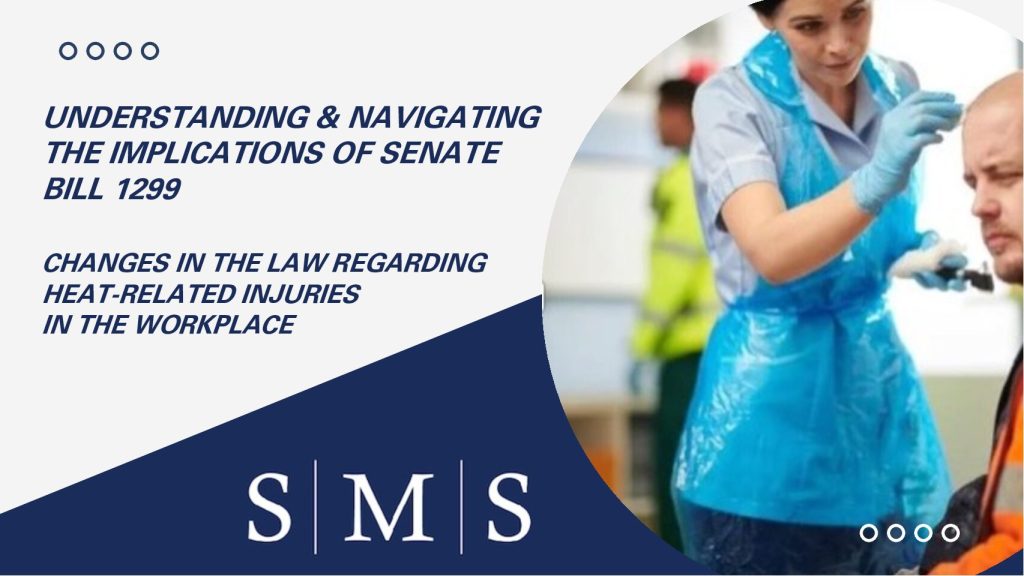
Understanding & Navigating the Implications of Senate Bill 1299

Understanding & Navigating the Implications of Senate Bill 1299 As the legal landscape of workers’ compensation in California continues to evolve, legal practitioners and insurance adjusters must stay informed about recent legislative developments that may impact their practice. Senate Bill 1299, recently passed in California, introduces significant changes regarding heat-related injuries in the workplace. In this article, we will explore the implications of SB 1299 for legal practitioners and insurance carriers, providing insights and guidance on how to navigate this new legislation effectively. Understanding Senate Bill 1299: Senate Bill 1299, which passed in May 2024, aims to create a presumption for heat-related injuries in the workplace. The bill now moves to the Assembly Insurance committee.  Under this legislation, if an employee working outdoors suffers a heat-related illness, it would be presumed to be a workplace injury, thereby shifting the burden of proof to the employer to rebut this presumption. This significant change has far-reaching implications for workers’ compensation defense in California, requiring legal practitioners and insurance adjusters to adapt their strategies accordingly. Implications for Legal Practitioners: For legal practitioners specializing in workers’ compensation defense, SB 1299 necessitates a thorough understanding of the new legal framework surrounding heat-related injuries. It is crucial to advise clients on the implications of this legislation and develop proactive defense strategies to mitigate potential liabilities. This may involve conducting comprehensive investigations, gathering relevant evidence, and effectively challenging presumptions of injury when appropriate. Implications for Insurance Examiners: Examiners tasked with administering workers’ compensation claims must also adapt to the changes introduced by SB 1299. It is essential to review and update claims handling procedures to ensure compliance with the new presumption for heat-related injuries. This may include enhancing safety protocols, providing additional training to employees, and collaborating closely with legal counsel to navigate complex claims effectively. Best Practices for Implementation: In light of SB 1299, legal practitioners and insurance adjusters should collaborate closely to develop best practices for implementing the new legislation. This may involve conducting regular reviews of claims files, staying informed about updates in caselaw and regulatory guidance, and fostering open communication with clients and stakeholders. By proactively addressing potential challenges and leveraging their collective expertise, legal practitioners and insurance adjusters can navigate the complexities of SB 1299 with confidence. Should Senate Bill 1299 become law, it would represent a significant shift in California’s workers’ compensation landscape, particularly concerning heat-related injuries in the workplace. Legal practitioners and insurance adjusters must educate themselves about the implications of this legislation and adapt their practices accordingly. By staying informed, collaborating effectively, and implementing best practices, they can effectively navigate the challenges posed by SB 1299 while upholding the rights of their clients and ensuring the integrity of the Workers’ Compensation system. Search for: Search Archives Archives Select Month September 2026 April 2020 March 2020 January 2020 November 2019 October 2019 September 2019 March 2019 February 2019 January 2019 August 2017 Subscribe To Our Blog First Name Last Name Email * Edit Template

Understanding & Navigating the Implications of Senate Bill 1299 Read More »

It’s Hotter than a Summer Day in California: Igniting Your Workers’ Compensation Subrogation Settlements

It’s Hotter than a Summer Day in California: Igniting Your Workers’ Compensation Subrogation Settlements Best Practices to Maximize Recovery at Mediation The Importance of Teamwork in Settlements Effective worker’s compensation settlements are a product of cohesive teamwork. The typical team includes: Third-Party Administrator Workers’ Compensation Subrogation Specialist Civil Subrogation Workers’ Compensation Adjuster Workers’ Compensation Defense Attorney Workers’ Compensation Carrier Workers’ Compensation Carrier’s Subrogation Specialist AOE/COE Investigator Consistent communication among team members is crucial. Key players such as the Subrogation Attorney and the Worker’s Compensation Defense Attorney must keep others informed about developments in the civil action and proceedings before the Worker’s Compensation Appeals Board (WCAB). Regular roundtables before key events help in coordinating and planning strategies. Tailoring the Settlement Plan Every case is unique, and the optional settlement plan depends on various factors known to different team members. For example: Claims representatives might not know the limitations of closing the worker’s compensation claim before the civil subrogation case is settled. Subrogation representatives may be unaware of significant claims issued that could influence an early settlement decision. Subrogation attorneys might not recognize the long-standing relationship between the employer and carrier. These diverse perspectives need to be integrated into the settlement strategy. Team members should proactively share critical information, including deposition transcripts, PQME reports, investigative reports, and witness statements. Early Settlement Goal Formulation Identify the possibility of a Third-Party Compromise & Release early. If not feasible, determine the best timing for a Compromise & Release. Assess whether a lien is sufficient or if active participation is warranted. For large cases, suggest that Plaintiff’s civil counsel make policy limits demand to open the civil third-party insurance policy, which can increase the potential recovery for both Plaintiff and WCAB credits. Counter-Intuitive Subrogation Mediation Subrogation in the civil arena can sometimes benefit from unconventional approaches. Rather than aiming for the highest possible direct monetary recovery, a settlement that stipulates credit or a third-party compromise and release might be more advantageous. This approach can close high-exposure claims, providing long-term benefits over immediate cash. Effective Mediation Briefs Primary Briefs should not educate the opponent on weaknesses but should coordinate with Plaintiff’s counsel to strengthen the Plaintiff’s case. Early filing allows the mediator and opponents to prepare adequately. A back-up brief should anticipate and counter the opponent’s best arguments assertively. Addressing Common Issues in Mediation Employer Fault Gather comparable reported cases for fault apportionment determinations. Use a WC Calculator to run scenarios of proportional fault and establish an “employer fault threshold” that must be exceeded for employer reimbursement. Privette Doctrine Remember, the Privette Doctrine may only bar claims against the general contractor, not the subcontractor primarily responsible for the injury. Collect evidence supporting the general contractor’s causation of injury through targeted discovery. Mediation: Subro Waiver and Common Fund Issues Ensure all conditions subsequent are performed and obtain all relevant insurance documents. Be prepared to show evidence of active participation and highlight key entries in subrogation attorney fees that are pertinent to the subrogation claim. Calculating Litigation Costs Get specific litigation costs from the Plaintiff’s attorney, at least a best estimate, for proportional Common Fund litigation cost calculation. Clarify that requesting this information does not admit that the Common Fund applies. Civil Rules Changes and Mediator’s Role Recent changes in civil rules have redefined the legal meanings of “writing” and “signing” (Cal. Ev. Code 250, Cal. State Bar Rule 1.0.1). The mediator’s role includes facilitating settlements while ensuring that the agreements are legally binding and enforceable. Critical Settlement Information Prepare alternative drafts of settlement documents like Release, Third-Party Compromise & Release, Compromise & Release, Stipulation & Award, and Finding & Award. Specify the principal terms, payees, timing of payment, and order of events. Mediation Privilege and Waiver Mediation remains a confidential process under Evidence Code Section 1119. Attorneys must provide clients with a printed disclosure of these confidentiality restrictions and obtain a signed acknowledgement (Evidence Code Section 1129). Conclusion Successful worker’s compensation subrogation settlements require a well-coordinated team effort, early goal formation, and a strategic approach to mediation. Keeping record of legal changes and ensuring clear communication and documentation can significantly enhance recovery and outcomes. Search for: Search Archives Archives Select Month September 2026 April 2020 March 2020 January 2020 November 2019 October 2019 September 2019 March 2019 February 2019 January 2019 August 2017 Subscribe To Our Blog First Name Last Name Email * Edit Template

It’s Hotter than a Summer Day in California: Igniting Your Workers’ Compensation Subrogation Settlements Read More »

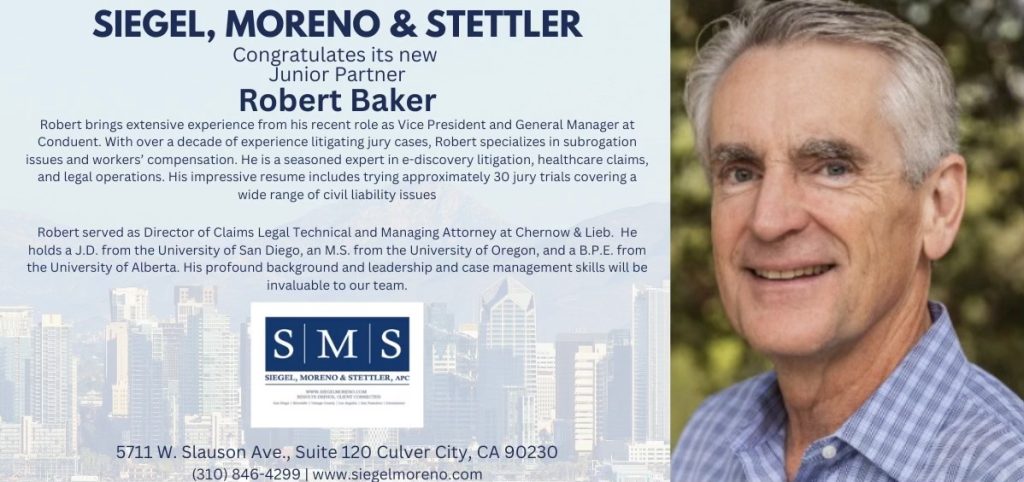
Congratulations, Mr. Baker!

Congratulations, Mr. Baker! Mr. Baker brings extensive experience successfully litigating jury  cases, specializing in subrogation. We welcome him as a Junior Partner with the firm and look forward to many more decades of success. Search for: Search Archives Archives Select Month September 2026 April 2020 March 2020 January 2020 November 2019 October 2019 September 2019 March 2019 February 2019 January 2019 August 2017 Subscribe To Our Blog First Name Last Name Email * Edit Template

Congratulations, Mr. Baker! Read More »

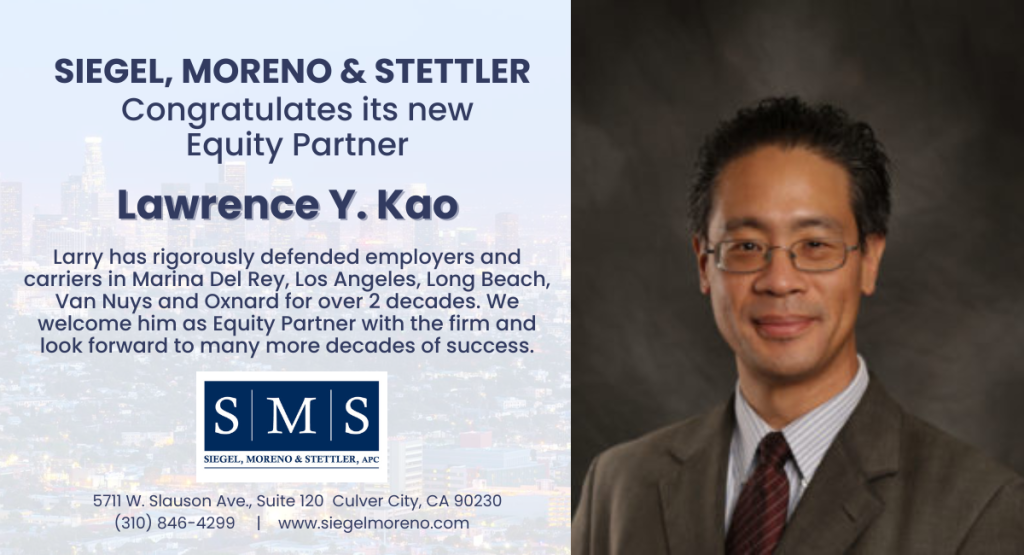
Congratulations, Mr. Kao!

Congratulations, Mr. Kao! Larry has rigorously defended employers and carriers in Marina Del Rey, Los Angeles, Long Beach, Van Nuys and Oxnard for over 2 decades. We welcome him as Equity Partner with the firm and look forward to many more decades of success. Search for: Search Archives Archives Select Month September 2026 April 2020 March 2020 January 2020 November 2019 October 2019 September 2019 March 2019 February 2019 January 2019 August 2017 Subscribe To Our Blog First Name Last Name Email * Edit Template

Congratulations, Mr. Kao! Read More »

A Win in the Battle of COVID Presumptions

A Win in the Battle of COVID Presumptions Finally, the defense catches a break in the world of COVID-19 presumptions. The California Supreme Court has finally issued its long-awaited opinion in the case of Kuciemba v. Victory Woodworks, ruling that an employer has no duty of care to household members of employees that have contracted COVID-19 on an industrial basis. Kuciemba v. Victory Woodworks, and its companion case, Ek v. See’s Candies, Inc., both ask the same question, in that can an Employer be held responsible to household, or family, members of an employee when that employee has been exposed to, and contracted, COVID-19 at the jobsite, and then brought said virus home, and passed same to household, or family members? In analyzing this situation, the Kuciemba Court compared this concept to previous lines of cases where the court did find such a duty on the Employer. In this regard, the court focused on the case of Kesner v. Superior Court of Alameda County. The Kesner case was decided by the California Supreme Court in 2016, and in that matter the court created a duty of care against the Employers in favor of household, or family, members when employees brought asbestos home, and potentially exposing those non-employee family members to asbestos related illnesses. So, one must ask the question, what did the California Supreme Court find different about the COVID-19 line of cases versus the asbestos line of cases? The court focused on public policy in finding the opposite outcome in the Kuciemba and See’s Candies, Inc. line of cases. In Kuciemba, the court specifically said, “[A]lthough it is foreseeable that the workplace spread of COVID-19 will cause members of employees’ household to contract the disease, recognizing a duty of care to non-employees in this context would impose an intolerable burden on employers in contravention of public policy.” In differentiating the asbestos line of cases, the court stated that while the only likely source for asbestos exposure would have been on the employer’s jobsite, the COVID-19 virus was highly contagious and encountered almost anywhere in society. Furthermore, the court focused on a person’s level of diligence in preventing contraction of, and spreading, of the COVID-19 virus. As a result, the court felt that the connection to the jobsite was not as direct with the COVID-19 virus as it was in the asbestos context. For whatever reasons the court has made a distinction in these lines of cases, and the policy considerations against finding liability against the employer seems to be playing a part. Despite thisruling, however, the court has not shut the door completely on this issue, and has acknowledged that their view in this scenario may change in the future, depending on how the COVID-19 pandemic evolves over time. Hopefully, this part of the case does not encourage the Applicant Attorney/Plaintiff Attorney bar to press this issue again in the future. Search for: Search Archives Archives Select Month September 2026 April 2020 March 2020 January 2020 November 2019 October 2019 September 2019 March 2019 February 2019 January 2019 August 2017 Subscribe To Our Blog First Name Last Name Email * Edit Template

A Win in the Battle of COVID Presumptions Read More »

Navigating Workers’ Compensation: The Critical Role of a Qualified Medical Evaluation Panel

Navigating Workers’ Compensation: The Critical Role of a Qualified Medical Evaluation Panel In the complex world of workers’ compensation, one of the critical elements that can significantly impact the outcome of a case is the selection of a Qualified Medical Evaluation (QME) panel. These panels play a pivotal role in determining the extent of an injured worker’s injuries, which in turn can affect the compensation they receive. In this article, I will delve into the importance of selecting an appropriate QME panel and the nuances of ensuring proper service of the panel upon all parties involved in a workers’ compensation case. The Significance of a Qualified Medical Evaluation Panel A Qualified Medical Evaluator (QME) panel is a group of medical professionals certified by the California Division of Workers’ Compensation to assess the medical condition of an injured worker. These evaluations are critical as they help determine the worker’s eligibility for benefits and the extent of their disability. The QME’s findings can profoundly impact the compensation awarded to the injured employee. Choosing the right QME panel is a crucial decision. An appropriately qualified panel can ensure a fair and accurate evaluation, whereas an inadequately chosen panel can lead to biased or inaccurate assessments. What key factors should you consider when deciding what or who is the best QME for you? Specialization: Look for a QME panel that specializes in the type of injury or medical condition the worker is facing. A specialist’s expertise can provide a more accurate evaluation. Too often we find ourselves arguing over the appropriateness of the specialty. The applicant’s side seems to always want chiropractors or pain management as opposed to orthopedics. Why? They tend to be more liberal and tend to recommend a greater amount of treatment before P&S status. Impartiality: It’s essential to choose a QME panel known for its impartiality. The panel members should not have any affiliations or biases that could influence their assessment. Your defense attorney can help you determine which particular doctor’s on a panel may have bias towards the defendant. Experience: Consider the experience of the QME panel. Seasoned professionals often provide more comprehensive and accurate evaluations. As a general rule of thumb, physicians who have been in practice for a longer period of time provide a more comprehensive and balanced assessment of the applicant. Reputation: Research the reputation of the QME panel in the workers’ compensation community. A panel with a solid track record is more likely to provide reliable assessments. We often find QME’s who are struck almost every time by the applicant side and the defense side. They have a poor reputation in the community as being biased for one side or the other. Note a common theme in looking at all of these factors. Your Defense attorney can be your best asset in obtaining a favorable panel, or minimizing the negative impact of an unfavorable one. Complying with the Regulations to ensure proper service The Labor Code establishes specific timelines that must be followed when requesting a panel of QME’s. Generally, a party must wait at least 10 days after mailing a request for a medical evaluation (plus 5 per the mailbox rule), pursuant to Labor Code §4060 through §4062. Because of the specific timeline, parties will often race to be first to obtain a panel in a specialty they believe will be most favorable to them. As of October 1, 2015, pursuant to CCR §30(b)(1)(c), all requests for initial panels must be submitted online. Once obtained, this section also requires a requesting party to do three things after obtaining a panel online: (1) serve the panel list, with a copy of any supporting documentation on the opposing party; (2) include a proof of service; and (3) serve within one working day after generating the QME list. Recently, in Lopez v. Rockstar Staffing, Inc., 2023 Cal. Wrk. Comp. P.D. LEXIS 199, the Workers’ Compensation Appeals Board held that a panel was invalid because it did not comply with CCR §30(b)(1)(C). In Lopez, the defendant had requested a panel on January 9, 2023, but failed to serve the panel until January 13, 2023, and also did not serve any of the supporting documentation. The Lopez case is a change in the Board’s prior stance to not invalidate panels in cases where defendants are not prejudiced by an applicant’s failure to strictly comply with 8 CCR §30(b). As such, parties should now cite Lopez when challenging the validity of panels when there’s a failure to comply with the rules. Conclusion Selecting a Qualified Medical Evaluation (QME) panel is a decision that should not be taken lightly. The right panel can ensure a fair and accurate assessment of an injured worker’s condition, while the wrong one may lead to a biased or inaccurate evaluation. Furthermore, ensuring proper service of the QME panel’s report is crucial for the timely resolution of workers’ compensation cases. At Siegel, Moreno & Stettler APC, we understand the complexities of the workers’ compensation system, and we guide our clients through the entire process, from selecting the right QME panel to ensuring proper service of their reports. Reach out to us with any questions you may have so we can get you the best panel possible. Search for: Search Archives Archives Select Month September 2026 April 2020 March 2020 January 2020 November 2019 October 2019 September 2019 March 2019 February 2019 January 2019 August 2017 Subscribe To Our Blog First Name Last Name Email * Edit Template

Navigating Workers’ Compensation: The Critical Role of a Qualified Medical Evaluation Panel Read More »