S | M | S

admin

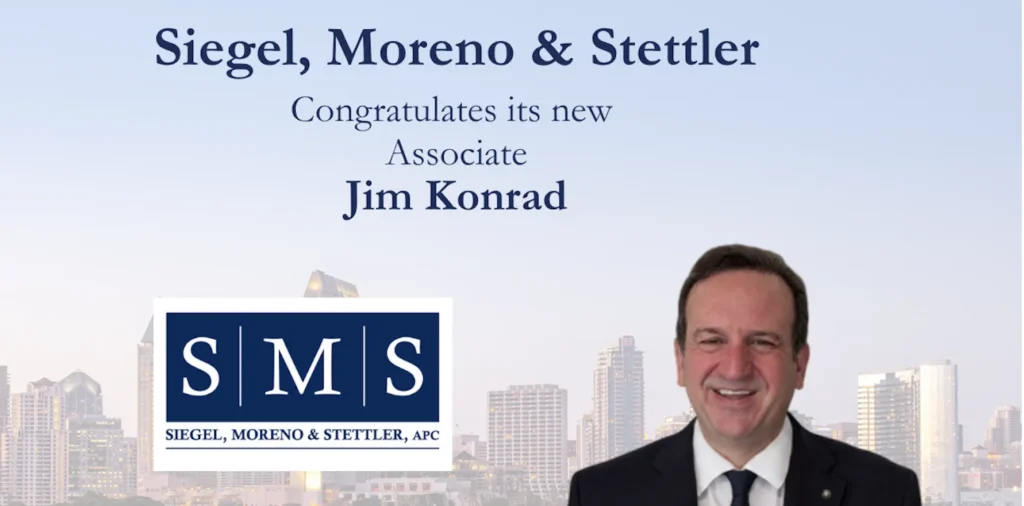
Congratulations, Mr. Konrad

Congratulations, Mr. Konrad Siegel, Moreno & Stettler is pleased to welcome Jim Konrad as the newest attorney at Siegel, Moreno & Stettler. Mr. Konrad brings experience in litigation, negotiation, legal research, contract analysis, and risk management. His practical approach to problem-solving and commitment to client service make him a great addition to our Workers’ Compensation Defense team. Mr. Konrad received his Juris Doctor from the University of Maryland School of Law and completed his undergraduate studies in Political Science at California State University, East Bay. We are excited to welcome him to the SMS team and look forward to his contributions to our clients and firm. Search for: Search Archives Archives Select Month September 2026 April 2020 March 2020 January 2020 November 2019 October 2019 September 2019 March 2019 February 2019 January 2019 August 2017 Subscribe To Our Blog First Name Last Name Email * Edit Template

Congratulations, Mr. Konrad Read More »

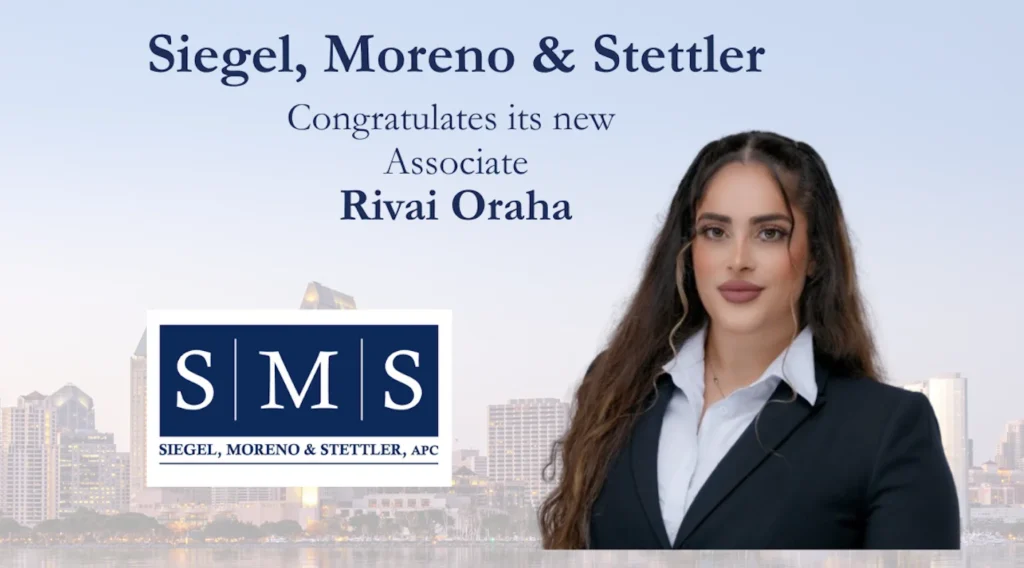
Congratulations, Ms. Oraha

Congratulations, Ms. Oraha Siegel, Moreno & Stettler is pleased to welcome Rivai Oraha as an Associate Attorney. Ms. Oraha brings hands-on experience supporting California workers’ compensation defense matters, including WCAB proceedings, case analysis, hearing preparation, client reporting, and litigation documentation. Her background includes reviewing medical and legal issues, preparing pleadings and settlement documents, coordinating with claims professionals and medical providers, and supporting the efficient resolution of complex workers’ compensation claims. Prior to joining the firm, Ms. Oraha gained valuable workers’ compensation defense experience with several California defense firms, where she developed a practical, client-focused approach to litigation support and case management. We are excited to have Rivai join the firm and look forward to the dedication, professionalism, and perspective she brings to our clients and team. Ms. Oraha earned her J.D. from California Western School of Law and holds a B.S. in Criminal Justice/Political Science from San Diego State University. Search for: Search Archives Archives Select Month September 2026 April 2020 March 2020 January 2020 November 2019 October 2019 September 2019 March 2019 February 2019 January 2019 August 2017 Subscribe To Our Blog First Name Last Name Email * Edit Template

Congratulations, Ms. Oraha Read More »

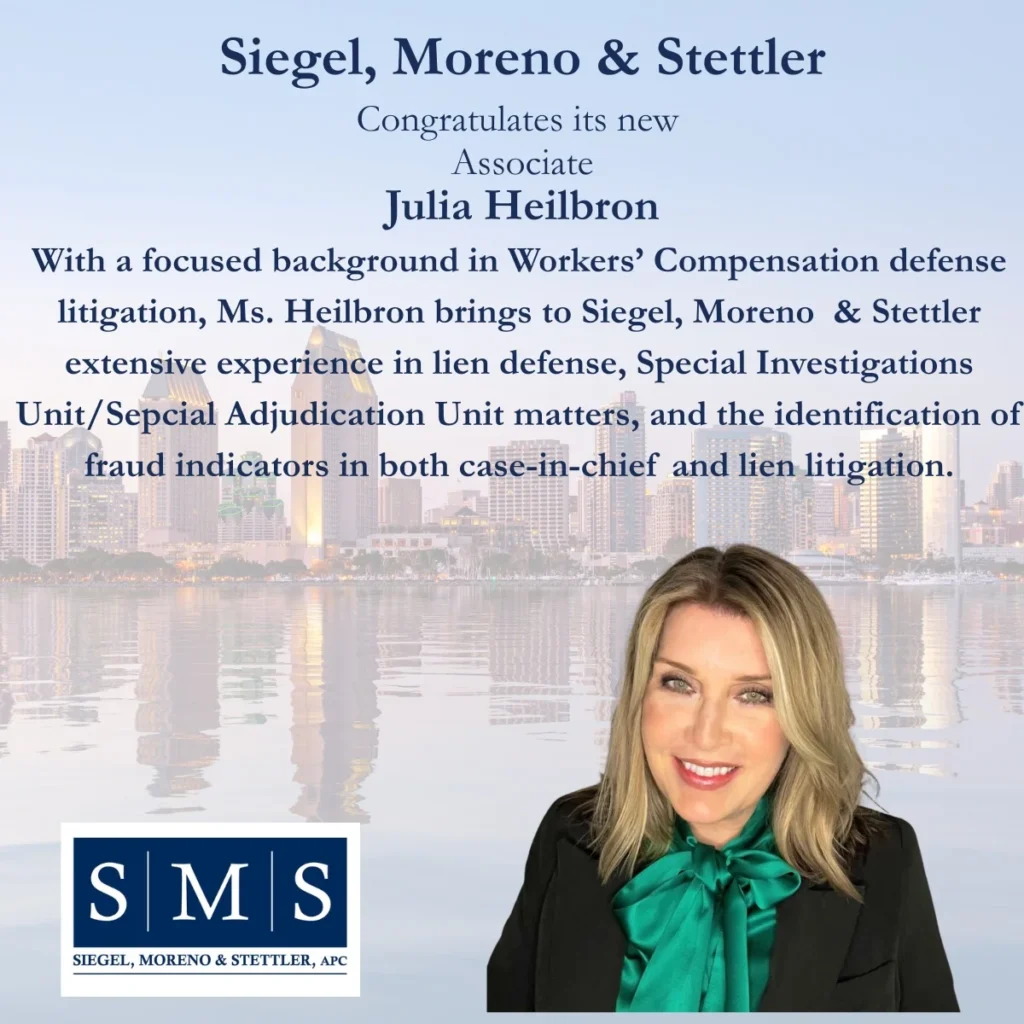
Congratulations, Ms. Heilbron

Congratulations, Ms. Heilbron Siegel, Moreno & Stettler is pleased to welcome Julia Heilbron as an Associate Attorney. Ms. Heilbron brings extensive experience in workers’ compensation defense litigation, with a particular focus on lien defense, Special Investigations Unit (SIU) and Special Adjudication Unit (SAU) matters, and the identification and prosecution of fraud-related issues in both case-in-chief and lien litigation. Her background includes representing employers, carriers, and third-party administrators in complex workers’ compensation matters throughout California. We are excited to have Julia join the firm and look forward to the knowledge, experience, and dedication she brings to our clients and team. Robert holds a J.D. from the University of San Diego, an M.S. from the University of Oregon, and a B.P.E. from the University of Alberta. Search for: Search Archives Archives Select Month September 2026 April 2020 March 2020 January 2020 November 2019 October 2019 September 2019 March 2019 February 2019 January 2019 August 2017 Subscribe To Our Blog First Name Last Name Email * Edit Template

Congratulations, Ms. Heilbron Read More »

Don’t like Interpreter market rates? Blame the defendants!

Don’t like Interpreter market rates? Blame the defendants! An analysis of interpreter market rates and an update on my current discovery and litigation with liens and Cost Petitions About two years ago, one of my favorite clients asked me to handle a Cost Petition over an alleged underpayment to an interpreter who had assisted at a hearing about two years prior. I accepted, largely as a learning experience. Up until that point, I had handled hundreds of interpreter liens through the traditional lien process, from informal negotiations through trial decisions, and had even successfully disposed of a prior Cost Petition by identifying a accounting mistake on the part of the interpreting agency. I was pretty aggressive in my response to the WCAB, which did the trick. I guess that was enough for my client to warrant a return to another Cost Petition with the same opposing counsel. Up to that point, I had only handled a few Labor Code §5811 Cost Petitions over the years and all were negotiation-based. Meaning, the client just wanted them to go away and were willing to pay for attorney’s fees to bring an end to the issue. From the start of that first Cost Petition with this client, I realized that they would rapidly become more popular (and they have), for at least two reasons. First, there is a conflict in the law that allows for multiple avenues to pursue collection of an interpreter bill. Even the most seasoned attorneys who specialize in only filing Cost Petitions (yes, there are a few) seem to confuse what is subject to IBR, non-IBR, a lien, or a Cost Petition under Labor Code §5811. Defense attorneys confuse them even more. As a side note, Labor Code §5811, WCAB Rule §10545 and a few other CCR provisions all have arguable overlaps pertaining to medical, medical-legal and “other” situations in which interpreters may render assistance. Second, is the claim of a “market rate” in general. Raise your hand if you have NOT seen an interpreter bill for anywhere between roughly $200-$400 for a minimum of two hours that is accompanied by a long, generic list of “other” comparable charges. No specifics, no case information. Nothing more than some random dates, a billed amount, and canned information as to what type of service the interpreter allegedly provided as their service. I see no hands raised. Boom! That is the all-powerful Kunz analysis that interpreters and their counsel attempt to roll up and smack the defendant over the head with as proof of their “market rate”. And time and time again, a defense attorney will glance at it and decide to compromise. Maybe that same attorney convinced the interpreting agency to knock a few bucks off per date of service. Maybe they threaten a threshold issue. Maybe the appearances get continued and the issue remains unsolved for a while. Yet, time and time again, the defendant coughs up big money for interpreters. Rinse and repeat. And they are not solely to blame. Claims examiners who have suffered through a long and drawn-out claim just want some peace and quiet and for those old dog claims to go the way of the ghost. No one likes dealing with those zombie files. And so, they offer authority and the matter is resolved. And don’t get me started on Judges. I have learned over the last year and a half that they too frequently don’t understand what goes into a Kunz analysis and what is required. They seem to dislike liens and Cost Petions even more than the defense side does, as lien conferences and hearings clog their already busy calendar. “Why aren’t both sides negotiating harder?” “Can’t your client come up with more money?” Again, raise your hand if you have NOT heard the same thing from a Judge on a case you have handled. Anyone? Anyone? I have gone to Trial on four such Cost Petitions over the last year or so, with some positive results. Of those, two have resolved with a lower payment obligation than what was demanded. Two resulted in no reimbursement due for attorney fees. All have slapped down overly broad discovery demands. I have negotiated three more. I have two that are pending being set for Trial at an upcoming appearance, with maybe six more in some other stage. In addition, I have two pending lien Trials for a Cost Petition and another for a lien filing where the WCAB has combined my request for discovery with the billing and demand for money. However, most of the work put into these cases has been defensive in nature, as I have jumped on the case after an appearance has already occurred, or well after a Cost Petition and demand for documentation has long been provided. Or, after a lien was filed for an interpreter and there either was a hearing pending, or one that had already occurred. Most of the work has been to clean up any issues and position the case for Trial. It wasn’t until fairly recently that we have finally been able to play some offense and aggressively demand discovery of our own. And what is the discovery? It stems from what I assume would be basic questions we should really know the answers to, if we are going to pay for a service. Such as, how is that market rate determined? What goes into it? What analysis goes into the Kunz paperwork the interpreters are presenting? What is the background of those other dates of service? I have found that the answers are hard to come by. Not just because interpreting agencies don’t want to provide me with basic information. That is to be expected. It seems that they can’t provide a substantive response. They just continue to use terms like “industry standard”, “trade secrets” and “Kunz analysis”. I recently had a lien claimant tell me with a straight face that knowing how the market rate is determined by her client and what

Don’t like Interpreter market rates? Blame the defendants! Read More »

Siegel, Moreno & Stettler Prevails: Take Nothing at Trial on Cost Petition for Interpreting Services

Siegel, Moreno & Stettler Prevails: Take Nothing at Trial on Cost Petition for Interpreting Services Timothy Rose, Esq. partner, and manager of our Northern California offices recently secured a ‘take nothing’ result at trial in Van Nuys WCAB, successfully defending against a demand for production of documents and a cost petition for unpaid interpreting services under Labor Code §5811. Case Background In January 2025, the defendant received an invoice for an unpaid interpreting service, a cost petition, and a notice to produce documents from a well-known cost petitioner attorney. This attorney is known for filing similar requests statewide and subsequently filed a motion to compel production of documents. Defense counsel responded with general objections to the petition for costs, the notice to produce, and the motion to compel, also filing for a protective order due to privilege and relevance concerns. A detailed request for production of documents was issued to the cost petitioner, but was ignored. The defendant ultimately paid the underlying invoice, clarifying that the original invoice had not been received until the packet arrived, and that there was insufficient evidence of prior billing. Litigation Strategy Despite payment, the cost petitioner pressed forward, demanding discovery, thousands of dollars in costs, and adverse presumptions for alleged unreasonable delay. At trial, his demand totaled $6,000 in fees. Defense counsel argued that the payment rendered the issue moot, that the requested discovery was irrelevant or privileged, and that there was no unreasonable delay or bad faith. The defense also challenged the cost petitioner’s failure to properly issue a 60-day demand before filing the petition and offered a nominal sum to resolve attorney fees, which was rejected. Outcome The court sided with the defendant on all issues, issuing a ‘take nothing’ Findings and Award. The judge found that the cost petitioner failed to meet and confer, improperly shifted the burden of proving bad faith, and relied on boilerplate filings insufficient to support his claims. Take Aways This is a great example of why it is important to properly respond to Notices to Produce and Petitions of any kind and to argue that boilerplate documents are often insufficient to properly address discovery issues. Additionally, it’s critical to make sure that the defendant is proactive in attempting to timely meet, confer, and resolve a dispute, if warranted. If you need guidance navigating these types of issues, we are always hereto help. Search for: Search Archives Archives Select Month September 2026 April 2020 March 2020 January 2020 November 2019 October 2019 September 2019 March 2019 February 2019 January 2019 August 2017 Subscribe To Our Blog First Name Last Name Email * Edit Template

Siegel, Moreno & Stettler Prevails: Take Nothing at Trial on Cost Petition for Interpreting Services Read More »

Are We Coming or Going? A Fresh Look at the Going-and-Coming Rule in Light of Zenith Ins. v. WCAB (Hernandez 2025)

Are We Coming or Going? A Fresh Look at the Going-and-Coming Rule in Light of Zenith Ins. v. WCAB (Hernandez 2025) The going-and-coming rule has long been a cornerstone of California workers’ compensation law, generally excluding injuries sustained during an employee’s commute from coverage. However, a recent decision by the California Court of Appeal—Zenith Ins. Co. v. WCAB (Hernandez)(2025) 110 Cal.App.5th 1164—has brought new clarity and imposed tighter limitations on the rule’s exceptions. What Happened? In this case, the 3rd District Court of Appeal reversed a Workers’ Compensation Appeals Board (WCAB) decision that had awarded benefits to a farmworker injured during a vanpool commute. The employee, Hernandez, was involved in a car crash while returning home in a van arranged by a coworker—not the employer. He had been commuting about 60 miles to work and did not possess a driver’s license. The WCAB had found that the special risk and dual-purpose exceptions to the going-and-coming rule applied, making the accident compensable. Appeals Court Decision: NO WAY – Not Compensable Generally speaking, an injury that occurs while commuting to work is compensable. Although there are exceptions, the judge significantly narrowed their application in this case: Special Risk Exception: This exception applies only if the injury occurs just outside the employer’s location and arises from a work-related risk beyond what the general public faces. In this case, the crash occurred far from the workplace and did not involve an employer-controlled hazard. The employee’s lack of a license, the legality of the van, and the long commute did not constitute a ‘special risk’ tied to employment. Dual-Purpose Exception: This exception applies when the commute also serves an intentional work function—such as making a sales call or picking up supplies before heading home. The Court found no evidence that Hernandez was performing any work-related duties during the trip. Practical Takeaways for Claims Handling The Special Risk Exception has become narrower than ever. For a commuting injury to be covered, the risk must be unusual, directly related to the employee’s work, and occur at or near the workplace. A long commute—say, 60 miles—does not meet the threshold on its own. Similarly, the Dual-Purpose Exception is difficult to establish unless there is clear work being performed during the commute. A mere benefit to the employer, such as punctuality, or casual oversight (like occasional calls) does not meet the standard. The burden of proof lies squarely on the employee’s side. Defense teams should push for strong evidence, such as employer-arranged transportation, clear documentation of work performed during the commute, or instructions from a supervisor given in the vehicle. Ultimately, evidence matters. Employers should maintain organized employment agreements, transportation policies, and ride-sharing waivers. Witness statements can also be crucial. It’s important to establish in writing that commuting is the employee’s responsibility, helping to avoid unnecessary liability in the event of a claim. Final Word For insurance carriers, TPAs, and defense attorneys, this decision is a significant win. It provides strong authority to argue that normal, employee-arranged commuting is not compensable. Treat ride-shares and carpooling as personal travel unless there is clear evidence to the contrary. When in doubt, ensure you document everything. If you need guidance navigating these complex exceptions or want to ensure your policies are airtight, we’re alwayshereto help. Search for: Search Archives Archives Select Month September 2026 April 2020 March 2020 January 2020 November 2019 October 2019 September 2019 March 2019 February 2019 January 2019 August 2017 Subscribe To Our Blog First Name Last Name Email * Edit Template

Are We Coming or Going? A Fresh Look at the Going-and-Coming Rule in Light of Zenith Ins. v. WCAB (Hernandez 2025) Read More »

Congratulations, Mr. Baker

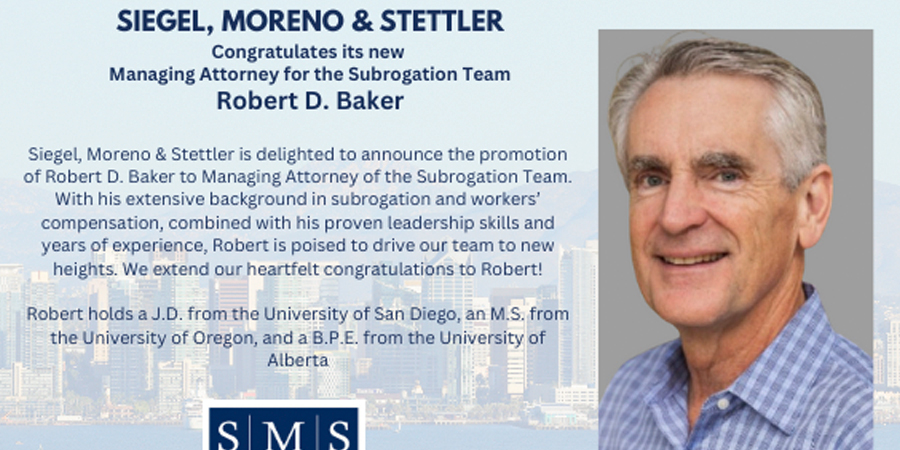
Congratulations, Mr. Baker Siegel, Moreno & Stettler is delighted to announce the promotion of Robert D. Baker to Managing Attorney of the Subrogation Team. With his extensive background in subrogation and workers’ compensation, combined with his proven leadership skills and years of experience, Robert is poised to drive our team to new heights. We extend our heartfelt congratulations to Robert! Robert holds a J.D. from the University of San Diego, an M.S. from the University of Oregon, and a B.P.E. from the University of Alberta Search for: Search Archives Archives Select Month September 2026 April 2020 March 2020 January 2020 November 2019 October 2019 September 2019 March 2019 February 2019 January 2019 August 2017 Subscribe To Our Blog First Name Last Name Email * Edit Template

Congratulations, Mr. Baker Read More »

Celebrating Excellence in Defense: Sanctions Imposed & 100% Savings Secured

Celebrating Excellence in Defense: Sanctions Imposed & 100% Savings Secured We are thrilled to share a significant victory achieved working with Argus West (https://arguswest.com/) and their SPEAR program. This case not only delivered 100% savings for our defendant but also underscored the importance of procedural compliance. Case Overview: In the lead-up to a recent worker’s compensation case that we were defending, the opposing party failed to provide a Pre-Trial Conference Statement (PTCS) despite multiple requests from both the defense and the presiding judge. After ongoing discussions, the Judge continued the matter to April 16, 2025, with the trial proceeding virtually. Given the continued non-compliance, the Judge indicated he would issue a Notice of Intent to order sanctions and granted permission for the defense to file a Petition for Costs due to repeated, unproductive appearances. Despite these warnings, the opposing party made no appearance at the continued trial on April 16 and never filed the required PTCS. Outcome: As a result, the Workers’ Compensation Appeals Board (WCAB) imposed $500 in sanctions – $250 for delaying the lien trial and another $250 for failing to follow the Judge’s order. This decision sends a strong message: even a withdrawn lien does not exempt a party from procedural accountability. Our very own Roshele Snyder’s commitment to enforcing compliance and delivering savings for our clients exemplifies the high standards we uphold at Siegel, Moreno & Stettler. We are proud to support our defense partners in achieving real results like this – resolving liens, enforcing compliance, and delivering meaningful savings. If you have a case you’d like us to review, we’re always here to help. Search for: Search Archives Archives Select Month September 2026 April 2020 March 2020 January 2020 November 2019 October 2019 September 2019 March 2019 February 2019 January 2019 August 2017 Subscribe To Our Blog First Name Last Name Email * Edit Template

Celebrating Excellence in Defense: Sanctions Imposed & 100% Savings Secured Read More »

Congratulations, Mr. Siavoshi

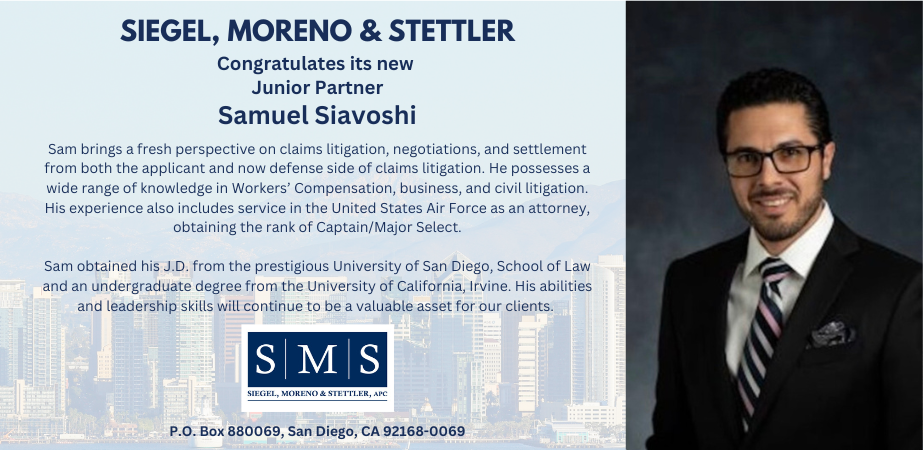
Congratulations, Mr. Siavoshi Sam brings a fresh perspective on claims litigation, negotiations and settlement from both the applicant and now defense side of claims litigation. He possess a wide range of knowledge in Workers’ Compensation, business and civil litigation. His experience also includes service in the United States Air Force as an attorney, obtaining the rank of Captain/Major Select. Sam obtained his J.D. from the prestigious University of San Diego, School of Law and an undergraduate degree from the University of California, Irvine. His abilities and leadership skills will continue to be a valuable asset for our clients. Search for: Search Archives Archives Select Month September 2026 April 2020 March 2020 January 2020 November 2019 October 2019 September 2019 March 2019 February 2019 January 2019 August 2017 Subscribe To Our Blog First Name Last Name Email * Edit Template

Congratulations, Mr. Siavoshi Read More »

Mileage Rate for Medical and Medical-Legal Travel Expenses Increases Effective January 1, 2025

Mileage Rate for Medical and Medical-Legal Travel Expenses Increases Effective January 1, 2025 REMINDER- Mileage Rate for Medical and Medical-Legal Travel Expenses Increases Effective January 1, 2025 Siegel, Moreno & Stettler APC wish to remind our clients that effective 1/1/25, there is a new mileage and travel reimbursement rate. The Division of Workers’ Compensation (DWC) announced the increase of the mileage rate for medical and medical-legal travel expenses by 3 cents to 70.0 cents per mile effective January 1, 2025. This rate must be paid for travel on or after January 1, 2025, regardless of the date of injury. Labor Code Section 4600, in conjunction with Government Code Section 19820 and the California Department of Human Resources regulations, establishes the rate payable for mileage reimbursement for medical and medical-legal expenses and ties it to the Internal Revenue Service (IRS). The updated mileage form is available on the DWC website, https://www.dir.ca.gov/dwc/I&A_mileageForm.pdf Search for: Search Archives Archives Select Month September 2026 April 2020 March 2020 January 2020 November 2019 October 2019 September 2019 March 2019 February 2019 January 2019 August 2017 Subscribe To Our Blog First Name Last Name Email * Edit Template

Mileage Rate for Medical and Medical-Legal Travel Expenses Increases Effective January 1, 2025 Read More »